


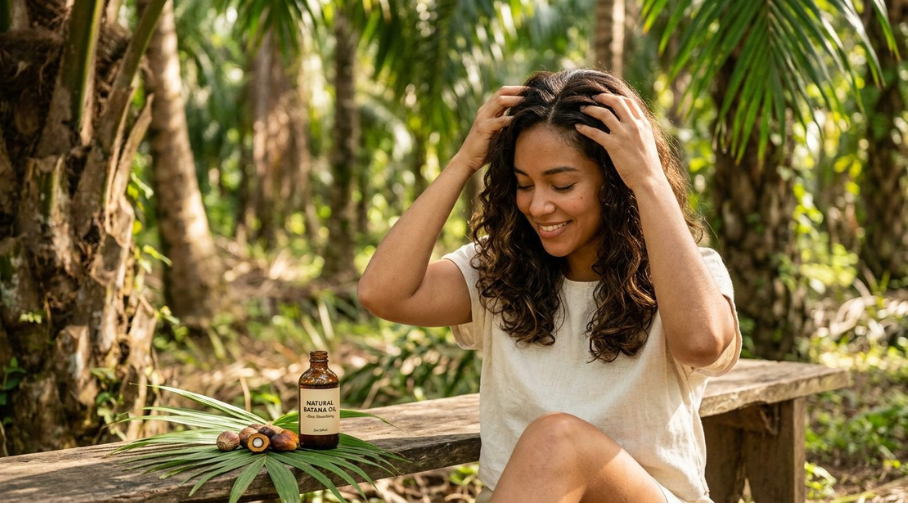
Batana oil hair growth is gaining popularity as a natural remedy for thinning hair and scalp care.
But there’s a lot of hype and confusion about what it can actually do.
While many users swear by its benefits, scientific evidence remains scarce.
This guide breaks down what’s real, what’s missing, and how to use batana oil for hair health without the marketing myths.
Key Takeaways
- There are no clinical studies proving batana oil hair growth benefits; all claims are anecdotal.
- Side effects are rare, but true results and before-after evidence are unverified and mostly influencer-driven.
- Best results come from consistent, proper application—though expectations should remain realistic.
Table of Contents
What Is Batana Oil for Hair Growth & Why the Buzz?
Batana oil comes from the nuts of the American oil palm (Elaeis oleifera). It’s a tradition long practiced by the Miskito people of Honduras.
Promoted as a natural solution for hair nourishment and even hair regrowth, it’s now a trending ingredient in global hair circles.
But does batana oil actually make hair grow, or is this more marketing than science?
Based on current research, there are no clinical trials or scientific studies directly proving any hair regrowth effects for batana oil.
Claims about reversing hair thinning or balding stem from anecdotal reports and social media influencers, not from laboratory or medical evidence.
Instead, most data points to its rich antioxidant and fatty acid content, which may support scalp health and hydration.
But this does not guarantee visible hair growth.
For those interested in holistic routines, batana oil often gets compared to ingredients found in natural hair care routines—think organic oils and gentle nourishing treatments.
However, expectations should stay grounded: Batana oil isn’t a miracle solution but can be part of a consistent self-care approach.
How to Use Batana Oil for Hair Growth: Step-by-Step
If you’re aiming to try batana oil for hair growth, here’s a realistic, evidence-aligned method to get the most from this traditional oil.
Given the lack of proven regrowth outcomes, focus on scalp and hair health benefits instead.
- Patch Test First: Always test a small amount on your inner arm or behind the ear for 24 hours to rule out any allergic reaction.
- Apply to Dry or Damp Scalp: Using clean fingers, gently massage a teaspoon of batana oil directly onto your scalp, including areas of thinning if desired. For extra conditioning, work the rest through the hair shaft to the ends.
- Leave In: Allow the oil to soak in for at least 30 minutes, or overnight for deeper nourishment. Protect bedding with a hair wrap or towel if leaving overnight.
- Wash Out Thoroughly: Use a gentle organic shampoo (ideally sulfate free) to remove residue. Repeat if needed to avoid build-up.
- Repeat 2–3 Times Weekly: While there’s no defined clinical protocol, this schedule provides consistent care without overwhelming the scalp.
- Combine with a Balanced Routine: Pair with good nutrition, stress management, and healthy scalp habits for best overall results. More details on routines can be found in this guide on natural hair care for healthy hair.
Remember, consistent gentle care—rather than high frequency—helps avoid clogged pores or oily build-up.
Those following organic self-care routines, like fans of organic anti-aging skincare or natural skincare treatments, will recognize this “less is more” approach.
Advanced Analysis & Common Pitfalls
Batana oil is surrounded by bold claims, but a realistic look reveals several common pitfalls for new users.
Here are the big three:
- Unrealistic Regrowth Expectations: There’s no clinical or photographic proof showing true hair regrowth. Any “before and after” you see is likely anecdotal. Set healthy expectations think softer, better nourished hair instead.
- Confusion Over Application: Many top articles avoid step-by-step protocols. Users often do not know how much, how frequently, or even where (scalp vs. full length) to apply the oil. (See our Step-by-Step above for clear guidance.)
- Risk of Build-Up or Allergic Reaction: Overusing batana oil without proper shampooing can leave hair greasy, limp, or even clog pores. Allergic response is rare but possible—always patch test.
Let’s look at how pure batana oil stacks up against commercial mixes:
| Feature | Pure Batana Oil (Organic) | Commercial Batana Mixes |
|---|---|---|
| Price (2024 data) | Data not available; varies | Data not available; varies |
| Potency Claims | No proven hair growth efficacy | No proven hair growth efficacy |
| Ingredient Transparency | Often clear (single-ingredient) | May include blends, less transparency |
| Side Effects | Allergy possible (rare) | Allergy possible (rare) |
| Market Growth (2024) | No industry data | No industry data |
Batana oil shares similarities with other trending ancestral beauty ingredients, like those found in beef tallow skincare or plant-based retinol alternatives.
But in all cases, ingredient knowledge is only the starting point, not clinical proof of benefit.

Conclusion
Batana oil is a traditional, antioxidant-rich natural product used for scalp and hair nourishment.
Robust proof for batana oil hair growth benefits simply does not exist.
It can be a comforting, enjoyable part of an organic hair care routine but should not be seen as a miracle cure for hair loss.
If you try it, use it thoughtfully, focus on healthy habits, and set realistic goals.
Want to discover more about truly effective, evidence-backed routines for hair and skin?
See our complete natural hair care guide and tips for healthy glowing skin—or explore the best solutions for clear, blemish-free skin and gentle organic baby care options.
Take your next step with reliable, honest guidance—your hair and scalp deserve it.
FAQ: Batana Oil Hair Growth Questions
Is batana oil proven to regrow hair?
No. Current research shows no clinical proof that batana oil causes hair to regrow. All claims are anecdotal or traditional, not backed by science. (Source)
Are there any side effects from using batana oil on the scalp?
Serious side effects are rare, but allergic reactions can occur in sensitive individuals. Always patch test before applying widely. (Source)
Can batana oil be used with other hair treatments or oils?
Yes, but start slowly. There are no data-backed guidelines on combining batana oil with other treatments, so watch for irritation and space out applications.
How often should batana oil be used for best results?
2–3 times per week is a good starting point for most, but there’s no evidence-based protocol. Adjust based on how your scalp and hair respond.
Does batana oil work for all hair types?
Most hair types tolerate batana oil well for scalp hydration and hair conditioning, but results and feel can vary. Curly, dry, or textured hair may benefit most.